
A plug that is 3 mm short of the correct reach will start the engine, idle cleanly and foul within a fortnight. A plug that is 3 mm too long can meet the piston on the first hard acceleration. Both arrive in identical boxes, and both are sold as 10 mm motorcycle spark plugs.
That is why motorcycle spark plug specifications deserve more attention than the part number printed on the carton. Four dimensions decide whether a plug fits at all: thread diameter, thread pitch, reach and hex size. Three more decide how it behaves once seated: heat range, electrode gap, and the resistor and terminal arrangement. The first group is a hard constraint. The second group is a tuning decision that should follow how the engine is actually ridden.
The practical rule we give customers is simple: measure the plug you are removing, match every dimension exactly, then choose the heat range from the duty cycle rather than from a catalogue description.
Content
Whatever is printed on the box, a motorcycle plug is fully described by six lines. If any one of them is wrong, the symptom usually appears somewhere else — a misfire blamed on the carburettor, a fouled plug blamed on fuel quality, or a stripped thread blamed on the mechanic.
| Specification | What it controls | Typical motorcycle range | Cost of getting it wrong |
|---|---|---|---|
| Thread diameter and pitch | Whether the plug will screw into the cylinder head | M10×1.0, M12×1.25, M14×1.25; M18×1.5 on older engines | A wrong pitch starts by hand and then tears the aluminium thread |
| Reach | How deep the spark sits in the combustion chamber | 12.7 mm and 19 mm most common; 9.5 mm on some short heads | Short: fouling and hard starting. Long: piston or valve contact |
| Hex size | Which socket can reach the plug in a tight frame or head recess | 16 mm, 20.8 mm, 22.2 mm; 14 mm on newer small engines | Rounded shell, or no access without dropping the engine |
| Heat range | How quickly the insulator tip sheds heat into the head | Manufacturer-specific scale, usually mid-range for road use | Too hot: pre-ignition. Too cold: carbon fouling and wet starting |
| Electrode gap | Voltage needed to jump the gap under compression | 0.6–0.7 mm points ignition, 0.8–0.9 mm electronic, up to 1.1 mm high energy | High-load misfire, hard cold starts, extra load on coil and CDI |
| Resistor and terminal | Electrical noise suppression and cap compatibility | Around 5 kΩ resistor; M4 stud or solid terminal | ECU or audio interference; a cap that will not clip on |
M14×1.25 remains the baseline for older and mid-size machines. Modern small-bore and high-revving engines have moved to M12×1.25 and M10×1.0, which is why a 14 mm socket from a 1990s toolkit often will not touch a current 150 cc head. Pitch is part of the size, not a footnote: an M14×1.5 plug will start in an M14×1.25 hole, feel tight far too early, and destroy the thread on removal.
Reach is measured from the seating surface to the end of the thread — never from the top of the hex. On gasket-seat plugs the crush washer defines that surface, and on tapered-seat plugs the taper itself does. The two are not interchangeable, and a gasket plug seated in a taper hole will leak compression and run hot.
Annotated cut-away: the gasket face is the reference plane for both reach and tightening torque.
A plug that is too short hides its spark inside the thread bore. Combustion is slow, the tip runs cold, carbon builds up on the insulator, and the engine becomes progressively harder to start from cold. A plug that is too long puts the electrodes into the piston path or into a valve pocket, creates a glowing hot spot that triggers pre-ignition, and bakes carbon onto the exposed threads so that removal strips the head. Neither failure is visible from outside the engine.
Hex size is the last of the fit dimensions and the one that decides whether the job takes five minutes or an hour. Most 10 mm and 12 mm plugs use a 16 mm hex, many 14 mm plugs use 20.8 mm, older 18 mm plugs use 22.2 mm, and several recent small engines have moved to a 14 mm hex to clear narrow head recesses.
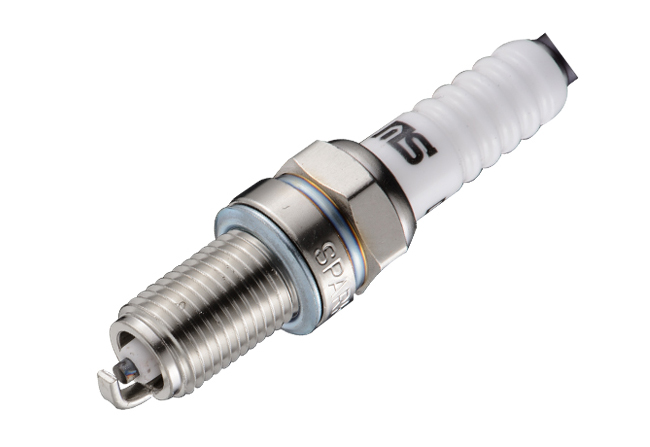
Patterns are only useful when the dimensions behind them are measured rather than assumed. Every motorcycle pattern we build starts from a sample and a dimension sheet: thread, pitch, reach, hex, seat type and terminal checked item by item before heat range is even discussed. The A7TC below is one of the most frequently requested small-bore patterns for exactly that reason.
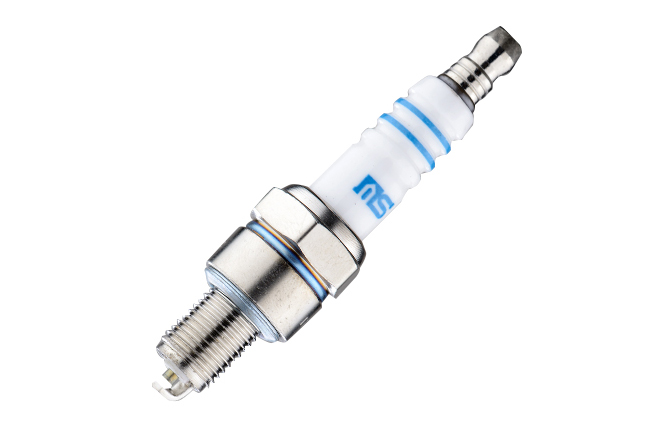 MS-MARSHAL A7TC Motorcycle Spark Plug, 12.7 mm ReachA frequently requested small-bore pattern with 10 mm thread, 1 mm pitch, gasket seat, copper-core center and nickel ground electrode.View Product →
The number in the code is a relative position on that manufacturer's scale. A 7 in one numbering system is not a 7 in another, which is why cross-reference tables should be trusted for dimensions and treated with caution for heat. What the number actually does is change how much insulator nose is exposed to combustion and how short the heat path to the shell becomes.
A hotter plug keeps more of the tip at self-cleaning temperature and burns deposits off; a colder plug dumps heat into the head faster and keeps the tip below the pre-ignition threshold. Selection follows duty, not preference: a stock commuter doing short trips in a cold climate sits well on the standard grade, while sustained highway riding, big-bore kits, raised compression, heavy loads or a hot climate usually justify one step colder.
Illustrative trend only: a higher rating runs a cooler tip, shifting the plug away from fouling and toward the pre-ignition margin.
Reading the plug after a few hundred kilometres is still the most reliable confirmation. A blistered white insulator, rounded electrode edges and glazed specks mean the tip is running too hot. Wet black soot points to a plug that is too cold — but check the mixture, the air filter and the ignition lead first, because a rich condition produces the same picture.
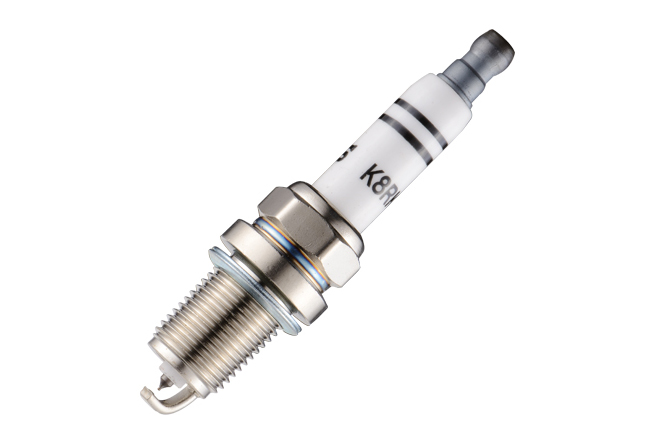
Heat rating is carried in the code itself, so a correction usually stays inside the same family. The CR8E pattern below uses rating 8 in its designation; going one step colder or hotter keeps the identical thread, reach and terminal and changes only that digit.
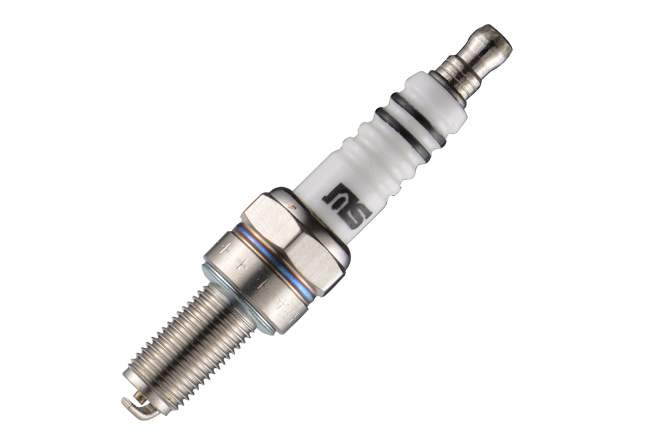 MS-MARSHAL CR8E Resistor Motorcycle Spark PlugRating 8 in the CR8E code keeps the same 12 mm thread, reach and terminal for one-step heat-range corrections; copper center and nickel ground.View Product →
Material choice changes service life and firing behaviour, not fit. A copper-core nickel alloy plug is the baseline: excellent conductivity, a stable gap, and the shortest replacement interval. Platinum pads resist erosion so the gap grows more slowly. A fine iridium tip needs less voltage to fire, resists fouling better on cold starts, and lasts longest — at the highest unit cost.
Qualitative comparison of common electrode materials based on general service behaviour, not a test of one specific product.
Gap is a separate decision from heat range. Points ignition systems typically ask for 0.6–0.7 mm, electronic ignition 0.8–0.9 mm, and high-energy systems up to 1.1 mm. Widening the gap raises the voltage required, which is fine on a healthy coil or CDI and a reliable source of high-load misfire on an ageing one. A useful reference on how to set the gap without damaging the electrode covers the gauge sequence in detail; the short version is that only the ground electrode is bent, and a fine iridium tip is never levered.
Resistor plugs, nominally around 5 kΩ, keep ignition noise out of CDI, ECU and audio circuits. A resistor that has failed open reads infinite resistance on a meter and produces a misfire that feels exactly like a fuelling fault. Non-resistor plugs belong only in old magneto systems that were designed for them.
Torque is not a formality. It controls heat transfer from shell to head as much as it controls retention. Under-torque leaves the shell running hot and allows combustion gas to escape past the gasket; over-torque stretches the shell, cracks the insulator and makes the next removal a thread repair job.
Gasket-seat values for reference only; tapered-seat plugs and aluminium heads often take lower figures — confirm with the engine manufacturer's manual.
Cross-reference books are useful and never final. Two codes can share M10×1.0, 19 mm and a 16 mm hex while sitting two heat steps apart, which is exactly the difference that turns a clean-running engine into a fouling one within a few hundred kilometres. Work through the list below with a caliper and a thread gauge in hand.
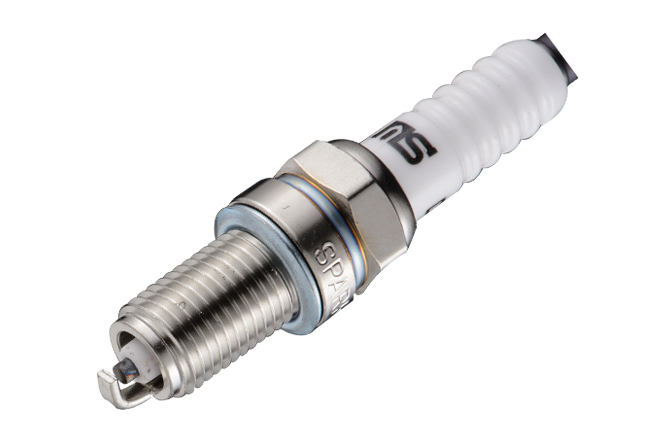
The full motorcycle spark plug range is organised so that a dimension sheet can be matched to a pattern directly. The D8TC below is a commonly requested example from that line.
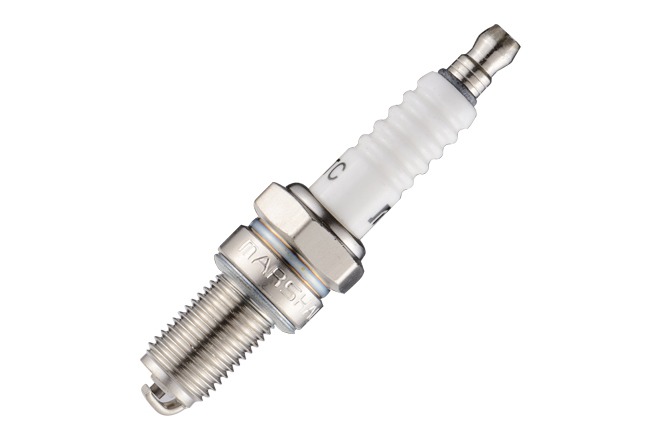 MS-MARSHAL D8TC 19 mm Reach Motorcycle Spark PlugA commonly requested 19 mm-reach pattern in the full motorcycle range, with 12 mm thread, 1.25 mm pitch, gasket seat, copper-core center and nickel ground.View Product →
Both of our motorcycle product families and their dimension data come from the same manufacturing chain as our automotive lines, including self-produced ceramic insulators and electrode assemblies that meet RoHS and REACH requirements — useful when a fleet buyer needs a consistent supply rather than a one-off box.
Most 150cc commuters use a 10 mm or 12 mm thread with a 16 mm hex, and either a 12.7 mm or 19 mm reach depending on the head. Heat range sits mid-scale with a 0.8–0.9 mm gap. Always measure the old plug first.
It is the heat rating — a position on that maker's scale, not a temperature. Higher numbers run cooler and suit hard, sustained work; lower numbers run hotter and clear deposits on short-trip engines.
No. Excess reach puts the electrodes into the piston path or a valve, causes hot spots and pre-ignition, and carbon-locks the threads so removal damages the head. Reach must match the original exactly.
Around 0.6–0.7 mm for points ignition, 0.8–0.9 mm for most electronic systems, and up to 1.1 mm for high-energy ignition. Check the manual before altering a factory pre-gap.
Yes on CDI or ECU-controlled machines — the resistor, usually near 5 kΩ, suppresses ignition noise. A failed resistor reads open circuit and mimics a fuelling fault. Non-resistor plugs only suit systems specified for them.
Inspect every 4,000–6,000 km and replace standard nickel plugs around 10,000–20,000 km. Iridium and platinum last longer. Two-strokes and oil-burning engines need shorter intervals.
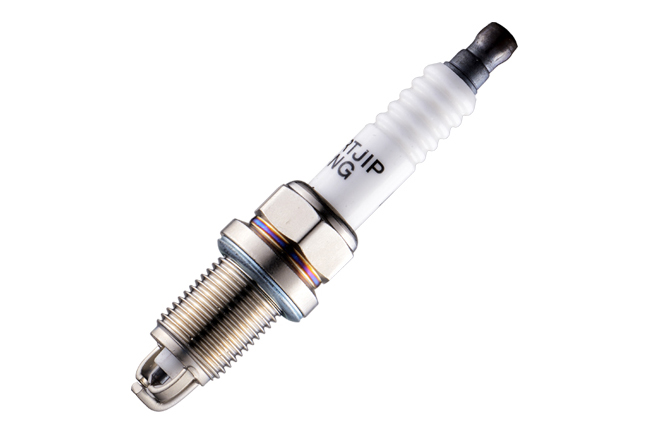

NINGBO MARSHAL AUTO PARTS CO., LTD. is a research and development, production and sales of professional manufacturers of spark plugs. Our company's spark plugs are mainly used in gasoline, natural gas and liquefied petroleum gas as fuel for all types of automobiles.
COPYRIGHT NINGBO MARSHAL AUTO PARTS CO., LTD. ALL RIGHTS RESERVED. Custom Spark Plugs Manufacturers OEM Spark Plugs Suppliers


 English
 中文简体