
A spark plug pulled at 40,000 km usually tells the same story: the gap has opened from about 0.8 mm to beyond 1.1 mm, the center electrode has lost its sharp edge, and the ground electrode looks thinner than the day it was installed. Nothing has broken. The electrodes simply eroded, which is exactly what they were designed to do.
So the conclusion first: spark plug electrode wear is a normal consumption process, not a manufacturing defect. Two mechanisms drive it, oxidation caused by heat cycling and electrical erosion caused by every spark, and their speed depends on electrode material, heat range, fuel and load. Knowing which mechanism dominates in your engine tells you whether a plug should last 30,000 km or more than 100,000 km, and whether a misfire is the plug's fault or a symptom of something deeper.
Content
SAE technical paper 2008-01-0092 describes two main wear modes on spark plug electrodes: oxidation wear due to thermal load, and sparking erosion caused by the discharge itself. They run at the same time, and one of them normally dominates.
Every combustion cycle swings the electrode tip from roughly 500 °C to over 800 °C and back, hundreds of times per minute. Metal expands, oxidizes and flakes away from the hottest surfaces, usually the center electrode tip and the inner face of the ground electrode. Lean mixtures and sustained high-speed running push peak temperatures higher and accelerate the loss, which is why a plug from a hard-driven engine can look worse than one from a lightly used city car.
Each spark vaporizes a microscopic amount of metal at the electrode surface. Nickel-copper alloys, the economical standard, erode fastest; platinum and iridium tips erode far more slowly because of their higher melting points and better oxidation resistance. The arc also migrates toward edges, so a rounded, eroded tip produces an unstable spark.
Both mechanisms show up as one number on a feeler gauge: the gap widens and the tip becomes blunt. A blunt electrode needs a higher breakdown voltage, so the coil and leads work harder as the plug ages. Once the required voltage approaches the coil's reserve, misfires begin, and they appear first under load and at cold start rather than at idle.
The plug is often the last component blamed and the first one to show evidence. The strongest influences are:
Figures are the service ranges commonly quoted in manufacturer service literature; real life depends on engine, fuel and driving pattern.
Colour and shape are diagnostic. A used plug is a logbook of the last few thousand kilometres, and the difference between normal erosion and a fault is usually obvious once you know what to look for.
| What you see | Most likely cause | What to do |
|---|---|---|
| Even light grey-brown tip, gap slightly over specification | Normal oxidation plus spark erosion | Replace the full set at the scheduled interval |
| Dry, sooty black coating | Carbon fouling from a rich mixture, short trips or weak ignition | Check air filter, thermostat and leads, then clean or replace |
| Wet, oily black deposits | Oil reaching the combustion chamber through guides, rings or a turbo seal | Replace and fix the oil source, or the new set will foul too |
| Blistered white insulator, rounded or partly melted center electrode | Overheating from a lean mixture, wrong heat range or over-advanced timing | Replace, fit the correct heat value, check cooling and fuelling |
| Pale ash deposits bridging the gap | Ash from coolant or oil additives | Replace and investigate a possible coolant leak |
| One plug clearly different from the rest | Cylinder-specific fault: injector, coil or a vacuum leak | Diagnose that cylinder rather than the whole engine |
| Bent ground electrode or cracked insulator | Mechanical damage during installation or handling | Replace, gap carefully and torque to specification |
Schematic view of the firing end: the gap marked in red is the dimension that grows as both electrodes lose material.
Erosion rarely announces itself. It shows up as a sequence of small annoyances that gradually become expensive:
Because the process is gradual, the driver adapts to it without noticing. For the everyday driving signs that accompany this wear, see why car spark plugs wear out.
Match the plug to the application rather than to the price tag. A standard nickel-copper plug is fine for an easy-access, low-load engine that gets serviced often. Platinum moves the replacement point further out and suits naturally aspirated engines with moderate mileage. Iridium and double-iridium tips give the most stable arc and the longest interval, which matters most on engines where one bank of plugs is buried under the intake manifold.
For modern engines that need both a durable tip and a stable ground side, an iridium center tip combined with a platinum ground pad, such as the K6RKAIP-11, is a practical middle path: the arc stays consistent for far longer, and the ground electrode resists the flame impingement that thins plain nickel.
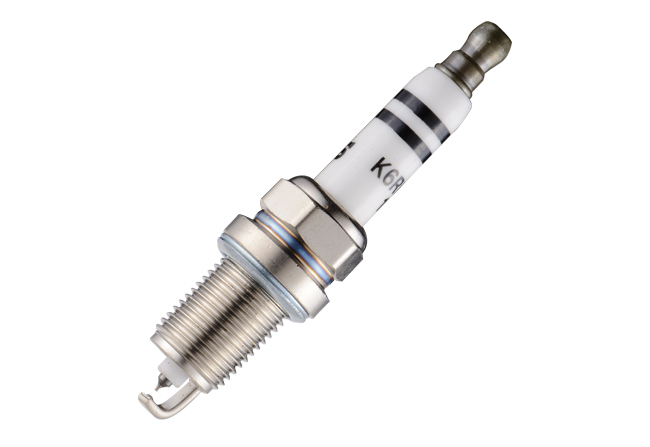 K6RKAIP-11 Iridium and Platinum Automotive Spark PlugIridium center tip and platinum ground pad with 14mm thread, 19mm reach, and resistor design for stable ignition.View Product →
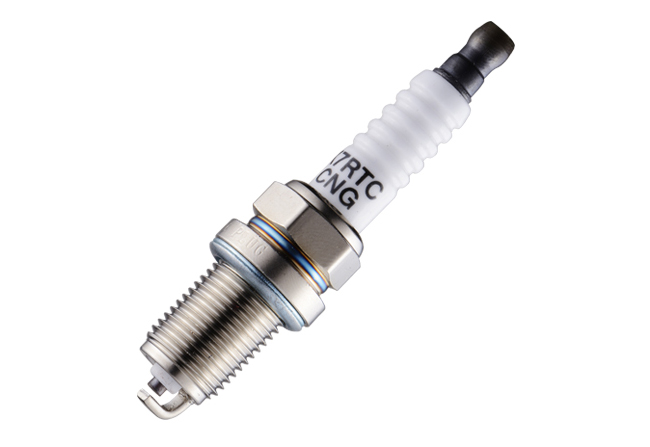
Compressed natural gas burns hotter and drier than gasoline, and the ignition system has to break down a mixture that is harder to ignite. That combination shortens electrode life noticeably, which is why CNG applications usually specify a dedicated model and a heat value chosen for the fuel rather than copied from the gasoline version of the same engine. A plug like the K7RTJC-CNG is developed for that duty cycle, with a tip and heat range matched to gas operation.
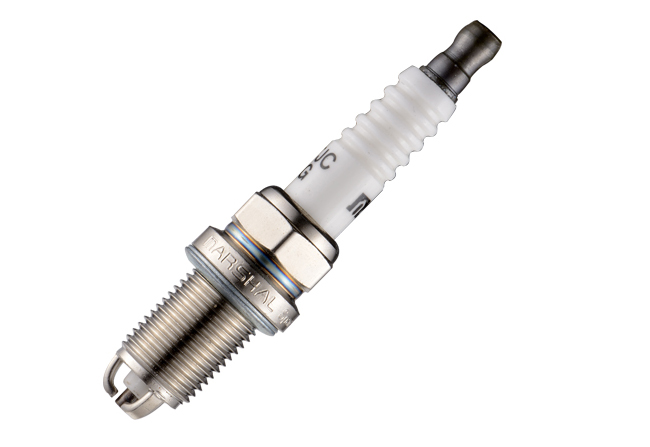 K7RTJC-CNG Compressed Natural Gas Automotive Spark PlugDedicated CNG plug with copper-core center and nickel ground electrodes, 14mm thread, 19mm reach, and heat range matched to gas operation.View Product →
Beyond electrode choice, thread size, reach and heat value all have to match the engine. The full automotive spark plug range covers gasoline, CNG and precious-metal variants so that a replacement can be selected by specification instead of by guesswork.
Two plugs can carry the same model number and still age differently. The difference usually sits in the joint between the tip and the electrode body: a poor weld creates a hot spot, and a hot spot erodes first. According to the manufacturer's technical documentation, Ningbo Marshal adopted German laser welding for precious-metal plugs in 2013 specifically to keep that weld zone small and the heat input low, and produces its own ceramic insulators in-house for tighter control of density and dielectric strength.
The same documentation states that the laboratory follows 17 international and national spark plug test standards, with an internal control standard covering more than 34 original-equipment-level checks, and that the electrodes are TUV certified and compliant with RoHS and REACH. For a buyer, the practical value is simple: a tip that stays attached and a gap that opens slowly are the two properties that decide whether a plug meets its stated interval.
Electrode wear is easy to manage if the checks are routine. A workable sequence looks like this:
Where cost per plug matters more than the longest possible interval, a conventional nickel model such as the K6RTC remains a sensible choice for older, easy-access engines that are serviced regularly.
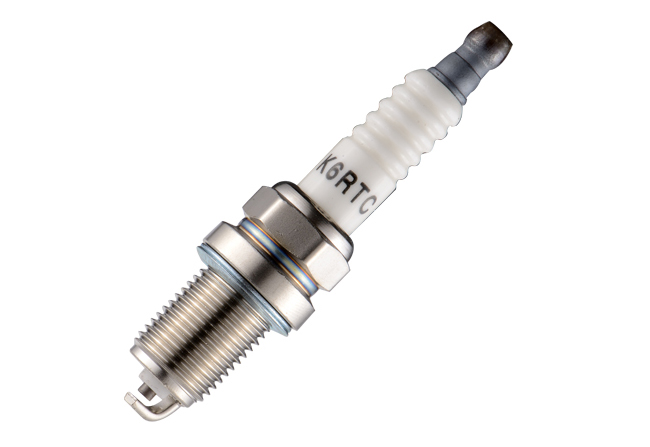 K6RTC Conventional Nickel Automotive Spark PlugCost-conscious nickel spark plug for older, easy-access engines serviced regularly, with customizable production and automotive spark plug specifications.View Product →
It is the gradual loss of metal from the center and ground electrodes, caused by heat-driven oxidation and by electrical erosion from every spark. The visible result is a wider gap and a blunter tip.
Nickel-copper plugs commonly last around 25,000 to 30,000 km, platinum roughly 60,000 to 100,000 km, and iridium plugs 100,000 km or more. Always follow the interval in your owner's manual first.
Check the gap with a wire gauge and look at the tip. A rounded center electrode, a thinned ground electrode, hard cold starts, rough idle or misfires under load all point to wear.
No. The tip is thin and brittle, so prying it can crack or detach the iridium pad, and a worn tip no longer produces a stable spark even at the correct gap. Replace it.
Yes. Iridium and platinum resist oxidation and erosion far better than nickel-copper, so the gap grows more slowly. They still cannot compensate for a rich mixture, oil consumption or a weak coil.
Generally yes. Gas fuels burn hotter and are harder to ignite, so dedicated CNG spark plugs with a matched heat value and a shorter replacement interval are the safer choice.
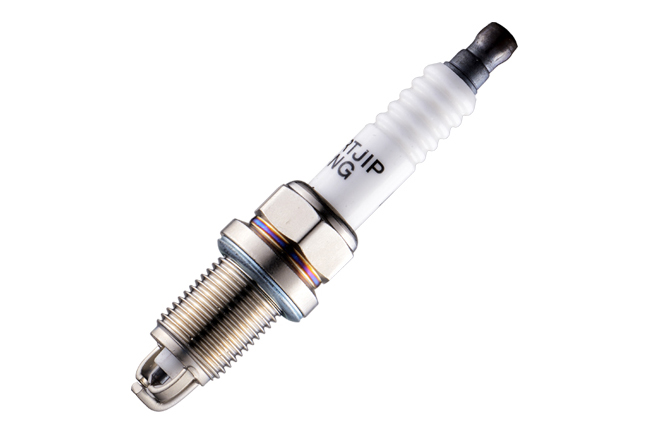

NINGBO MARSHAL AUTO PARTS CO., LTD. is a research and development, production and sales of professional manufacturers of spark plugs. Our company's spark plugs are mainly used in gasoline, natural gas and liquefied petroleum gas as fuel for all types of automobiles.
COPYRIGHT NINGBO MARSHAL AUTO PARTS CO., LTD. ALL RIGHTS RESERVED. Custom Spark Plugs Manufacturers OEM Spark Plugs Suppliers


 English
 中文简体